Complex codes. Simple answers.
Building codes are written in a language most people weren't trained to speak. pyrmit reads them so you don't have to — and gives you plain-English answers, with the source to back it up.
⌄
Building codes are written in a language most people weren't trained to speak. pyrmit reads them so you don't have to — and gives you plain-English answers, with the source to back it up.
Each one can adopt its own version of the building code, layer on its own amendments, and enforce its own edition — which may be anywhere from 3 to 18 years behind the current standard. Knowing which code applies to your project is itself a research task before the actual research begins.
It operates under a suite of them — building, electrical, plumbing, mechanical, fire, energy — each published by a different body, updated on a different cycle, and cross-referencing dozens of other standards you also have to track. The electrical code alone is currently being enforced in four different editions simultaneously across U.S. states.
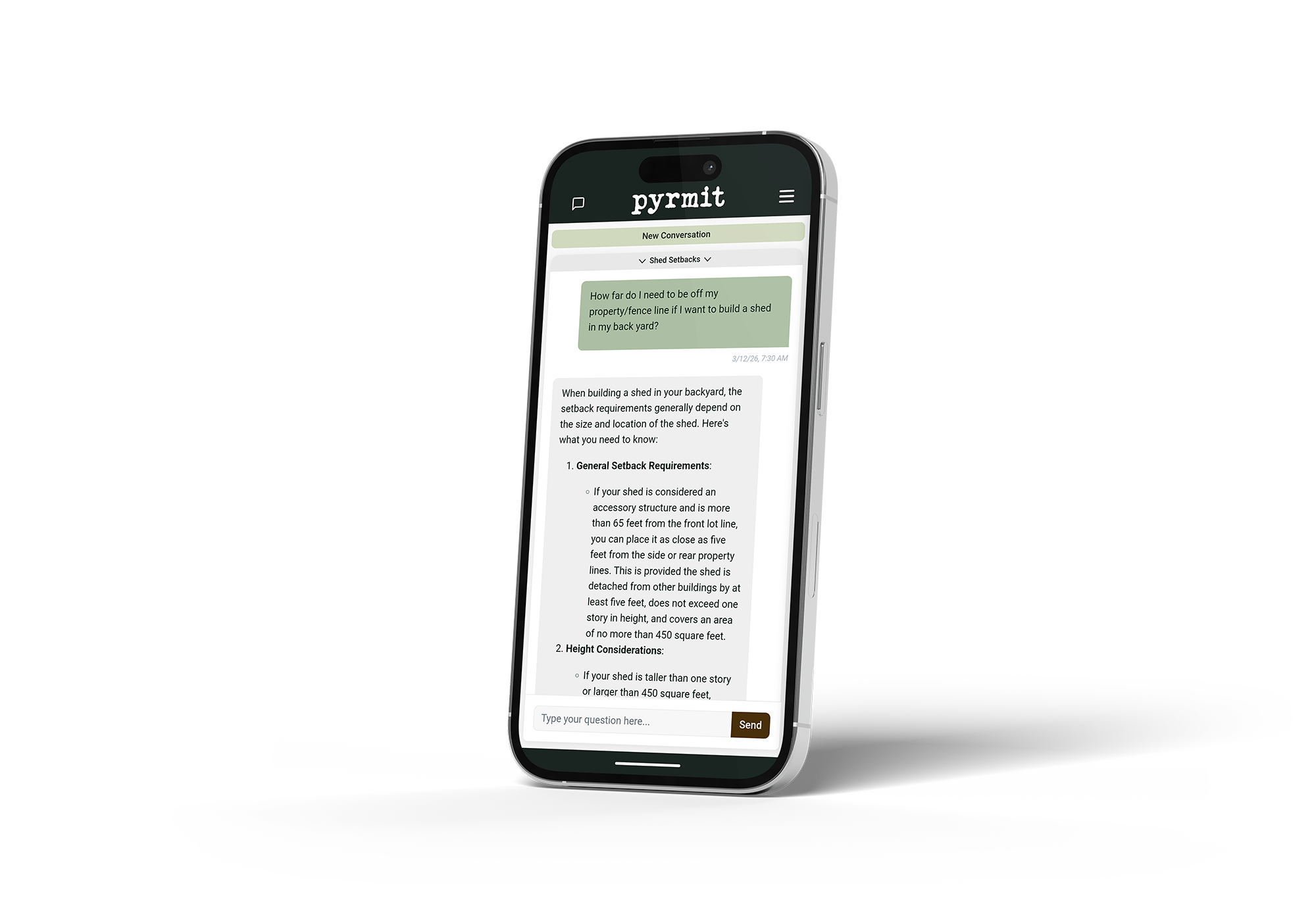
They're written at a post-secondary reading level — dense, recursive, full of internal references that send you three documents deep before you find the actual answer. You didn't ask for "the maximum vertical dimension of an accessory structure as permitted under the applicable setback provisions." You asked how tall you can build a shed.
82% of developers say building codes are difficult to interpret. 92% cite variation between jurisdictions as their primary compliance challenge. Nearly half of all residential plan submissions are denied on first review — not because the work was wrong, but because the code wasn't fully understood before the plans were drawn.
No code terminology required. Ask the way you'd ask a colleague. pyrmit handles the translation.
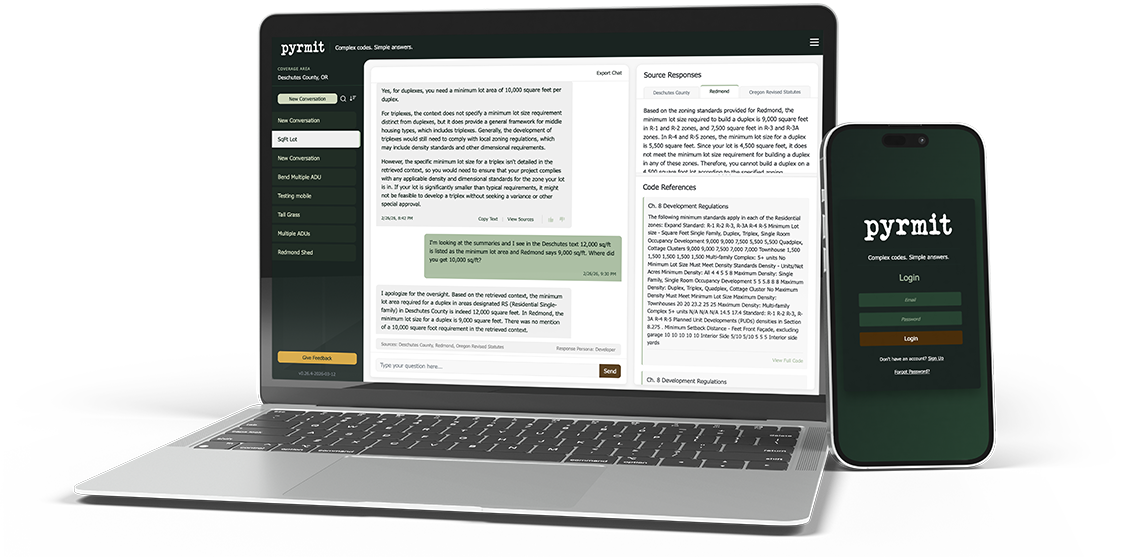
Not the web. Not training data. The specific building codes, amendments, and overlays that apply to your jurisdiction — pulled from verified source documents and searched in real time.
A plain-English response that tells you what the code says, where it says it, and which document it came from. Cite it, share it, build on it.

Your clients ask questions you're expected to answer on the spot — setbacks, ADU eligibility, permitted use, fence height, deck permits. They don't want "I'll find out and get back to you." They want an answer now, and they want to trust it. A defensible, cited response is available in the time it takes to pull out your phone — no rabbit holes, no municipal websites, no hoping the county PDF loads.

Before you close, you need to know what a property can actually do. Can you add a unit? What does the zoning allow? Are there setback restrictions that kill the addition you're planning? These questions have answers — they're just buried in code documents most people don't know how to navigate. pyrmit finds them before they become expensive surprises in due diligence or, worse, after closing.

You know the codes. But you work across jurisdictions, and every jurisdiction has its own version, its own amendments, its own edition — some of them years behind the current standard. What's true in Bend isn't necessarily true in Redmond. What applied on your last job may not apply on this one. pyrmit keeps you grounded in what actually governs the job site you're standing on right now, not the one you were on last month.

Code compliance isn't a footnote on your pro forma — it determines whether a project is feasible at all. Setback requirements, height limits, parking ratios, accessibility overlays, energy code amendments — each one can reshape a design or kill a deal. pyrmit lets you run those questions early, when the answers can still change the plan, not after the architect has drawn three rounds of plans against the wrong code.

When a contractor pushes back on your interpretation, the answer is in the document — the right document, the right edition, the right jurisdictional layer. Finding it fast matters. pyrmit helps you locate the governing provision, confirm which version is in force, and cite it precisely. Less time in the field searching, more time on the work that actually requires your judgment.

Your designs live or die on code compliance, and the research load is relentless. Occupancy classifications, egress requirements, structural load references, energy compliance paths — each project means hours in the code before a line gets drawn. It won't replace your expertise, but it gives you a research layer that works as fast as you think. Ask in plain language, get a cited answer, move forward.

You're planning a deck, an ADU, a fence, a shed, a bathroom remodel. Before you buy materials or hire anyone, you need to know what the rules actually are — not what your neighbor thinks, not what a forum post from four years ago says, not a guess. pyrmit reads your local code and gives you a plain-English answer with the source attached. Know the rules before the inspector shows up.

Code language is evidence, and jurisdiction matters. Whether you're litigating a construction defect, advising on a land use dispute, or reviewing a contract for compliance exposure, you need the applicable provision from the right document in the right edition — fast. The answer comes back cited, sourced, and jurisdictionally specific. Less time on code research means more time on the work only you can do.
Why not just ask ChatGPT?
The general AI tools — ChatGPT, Gemini, Claude — are brilliant generalists. They've read everything and verified nothing. When you ask a code question, they return a confident answer assembled from training data that may be outdated, jurisdiction-mixed, or simply wrong. They have no way to tell you "this is the Deschutes County Code, Section 8.24, adopted 2022."
The problem isn't access to information. It's the absence of verified, jurisdiction-specific answers you can actually stand behind.
pyrmit uses the same AI intelligence. The difference is what it's grounded in — specific documents, specific jurisdictions, citations you can verify. Not training data. Not crowd-sourced noise. The actual code.
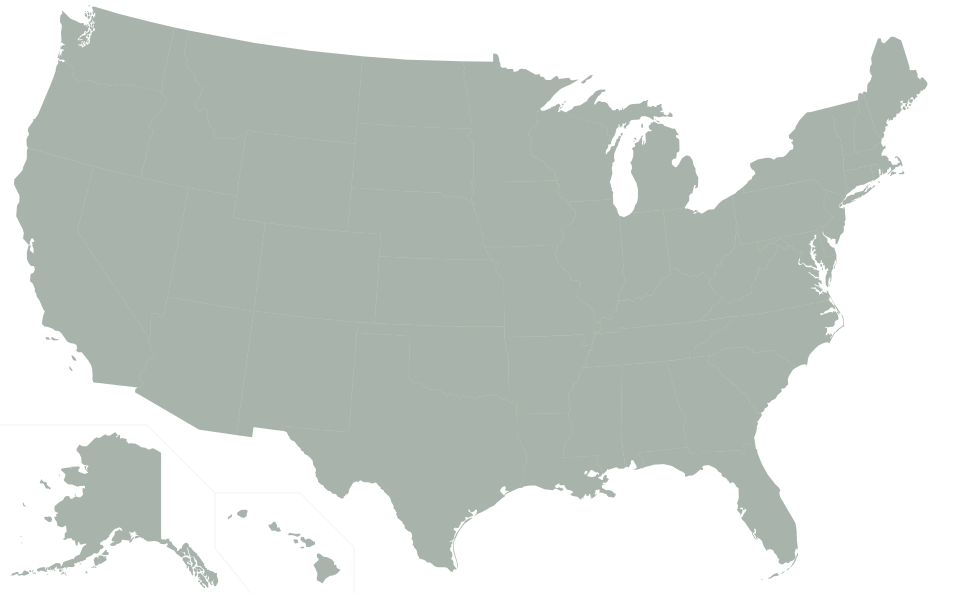
The architecture behind pyrmit is designed for expansion — any state, any jurisdiction, any code. We handle the sourcing, the indexing, and the layering so you don't have to think about it.
Don't see your area? Let's talk. If you work in a jurisdiction that isn't covered yet, reach out. We've built this to scale, and we'd rather bring it to you than have you work without it.
Contact us about your jurisdiction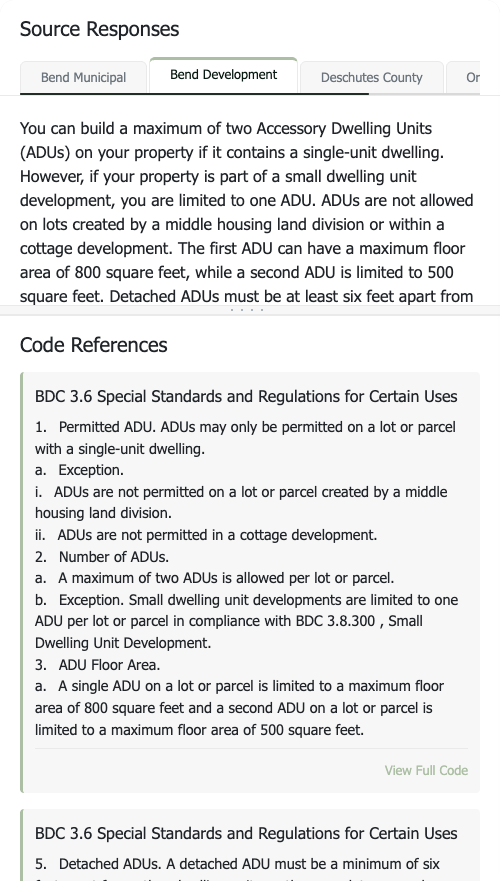
pyrmit is a retrieval-augmented generation system grounded in jurisdiction-specific vector indexes.
When you submit a query, a retrieval planner evaluates which sources are available for your jurisdiction — state base code, county amendments, municipal overlays — establishes precedence, and pulls weighted chunks from the relevant indexes before a single token is generated. The system knows what it has access to before it starts looking.
The model synthesizes from retrieved context, not training weights. It can't invent a section that wasn't retrieved. That distinction matters more than it sounds.
Jurisdiction layering is intentional. Base codes contribute at a lower retrieval weight. Overlay sources — amendments, local adoptions — surface at higher priority. The answer reflects the effective code for your location, not just the closest keyword match.
The rest are guessing.
pyrmit knows where to look.
pyrmit is currently available by invitation. If you're a real estate professional, builder, inspector, or trade contractor who needs better answers faster, we'd like to hear from you.
Request AccessAlready have an account? Sign in above.

Navigation